The Cyberpunk Future I Wish to Build
Not the one Hollywood sold you. Not the neon-soaked dystopia where corporations own the sky and the rain is acid and the only people with power are the ones who already had it. That’s not cyberpunk. That’s just now with better lighting and worse pollution.
The future I imagine is more integrated with nature, quieter, more alive. If I could travel forward a few hundred years this is what I’d hope to see:
The Buildings
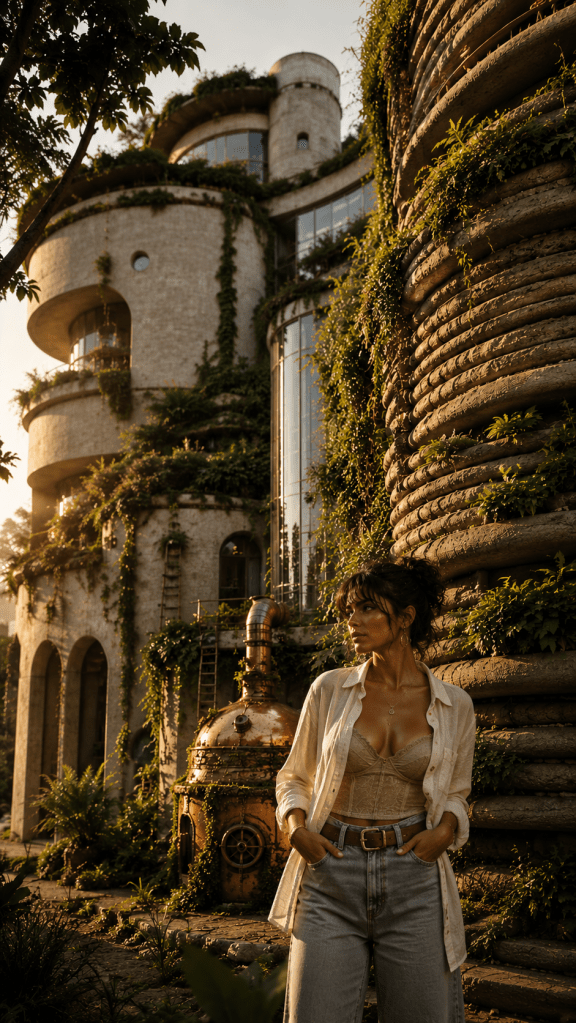
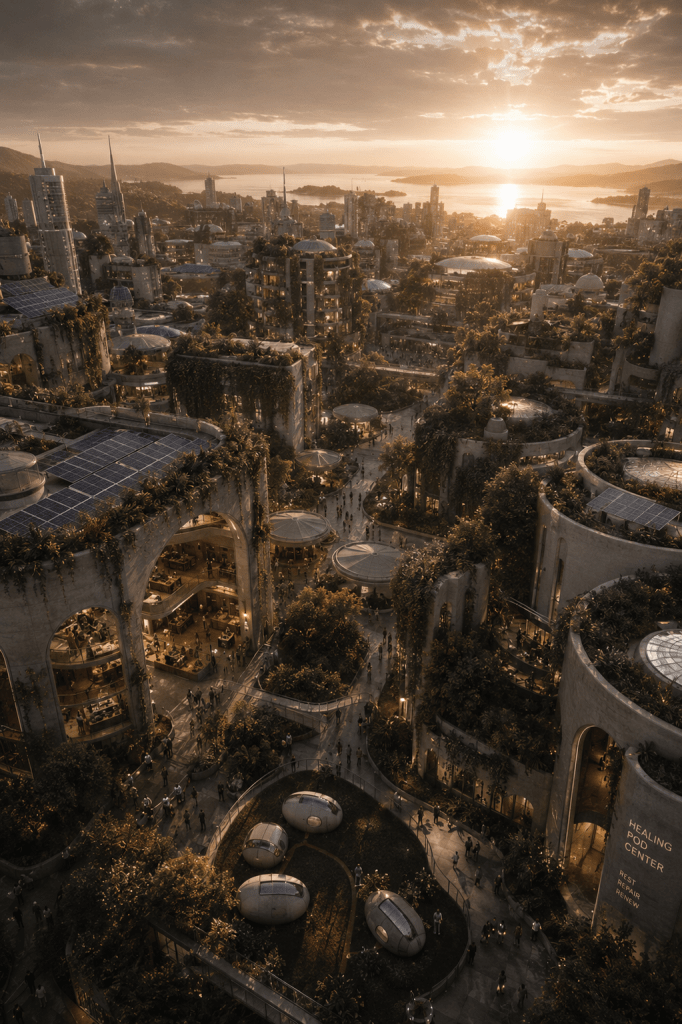
The buildings are 3D printed or hand-formed from natural materials by their human makers or robots— cobb, hempcrete, adobe brick, hyper adobe, compressed earth, mycelium, reclaimed stone, ethically grown and harvested woods, biocomposite alloys stronger than steel that will return to the ground when they’re done. Cobb — that ancient mixture of clay, sand, and straw that has housed humans for thousands of years and outlasted every trend in construction — built into curved walls with no formwork, no waste, no off-gassing. Hyperadobe — compressed earth in continuous tubes, stacked and tamped into structures that are simultaneously load-bearing and breathable, requiring almost nothing from industrial supply chains. Roman concrete — the formula we lost for centuries and recently rediscovered — which does not weaken over time but grows stronger as it interacts with its environment, which self-heals its own cracks, which the ocean has been demonstrating for two thousand years at Caesarea and Pozzuoli while our modern concrete crumbles in decades.
These are not primitive materials. They are the most sophisticated building technologies in human history, abandoned not because better ones replaced them but because they couldn’t be owned, patented, or extracted from. You cannot put a royalty on cob. You cannot monopolize hyperadobe. Roman concrete’s key ingredient — volcanic ash — is not a controlled substance. The future I’m describing is partly just remembering what we already knew and choosing it again deliberately but executing it with the modern digital technology, advanced machinery and updated safety methodologies of today.
They are thermal mass. They breathe with the temperature, hold heat in winter, release it in summer. They grow food on their faces — vertical gardens climbing every surface, herbs in the windows, living walls that clean the air and feed the people inside simultaneously. The building is not separate from the ecosystem. It is part of it.
Nothing goes in the aquifers or river water that doesn’t belong there. Human waste becomes biogas — captured, processed, converted into fuel for the heavy machinery that grows and builds and moves things. The loop closes. What the body produces feeds the system that feeds the body. This is not new technology. Decentralized waste management solutions can take pressure of water treatment plants and infrastructure maintenance costs in areas where pollution is a big issue.
The Energy
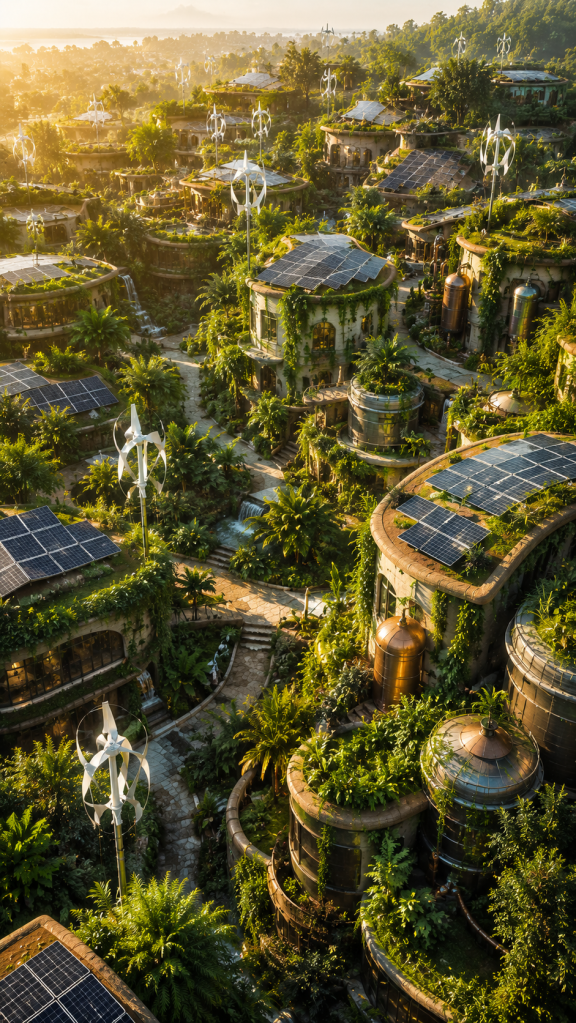
Energy is not one thing. It is everything — zero point, solar, thermal, wood, gas, wind, whatever the land offers. Decentralized. Nobody owns the grid because there is no single grid to own. Every building generates. Every neighborhood stores. Every community decides how its energy flows.
The single point of failure that makes entire cities vulnerable to one decision by one corporation — gone. Redundancy is built into the infrastructure the way it is built into nature. Everything has a backup. Everything cycles. The catastrophic fragility of a centralized system replaced by the quiet resilience of a thousand small ones.
The Production
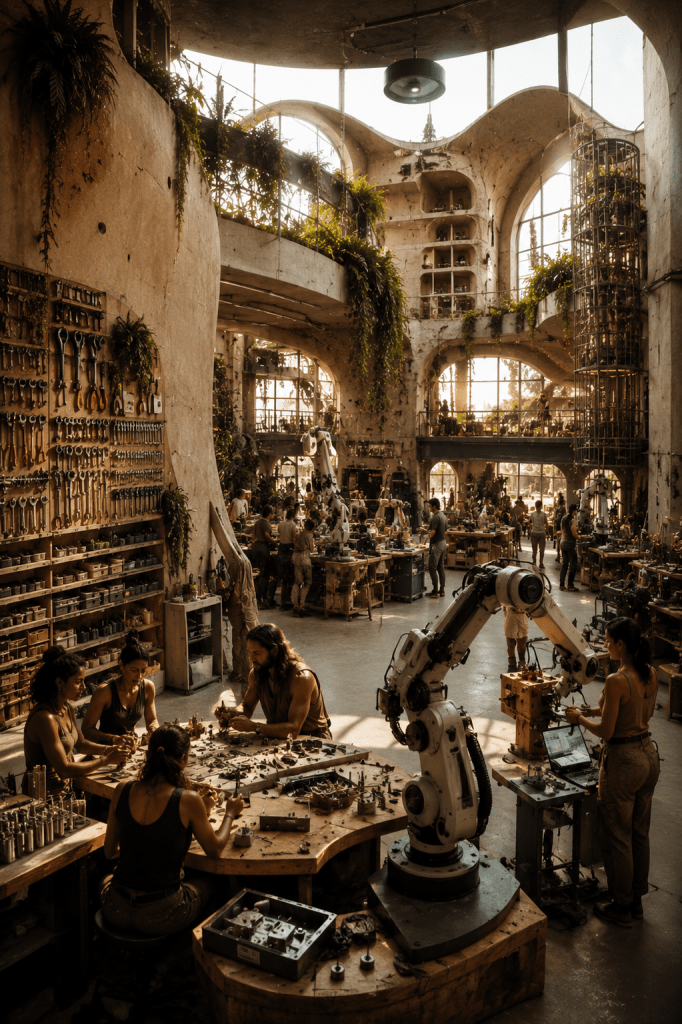
Production happens locally. The open factory — structured like a public library, accessible to anyone, powered by automation, teaching skills while it manufactures goods — is on every block. You walk in with an idea and you walk out with a thing.
The bottleneck of supplier and distributor eliminated. The means of production held by the community that uses them. Automation deployed not to replace workers but to free them — to handle the repetitive, the dangerous, the cognitively exhausting — so the humans can do what only humans do. Design. Decide. Create. Connect.
Nine AM is COB because the hard stuff is automated to be done from 5 am to 9 am. Survival is already handled. The rest of the day belongs to everything above producing just enough to keep food, housing, water.
The Healing
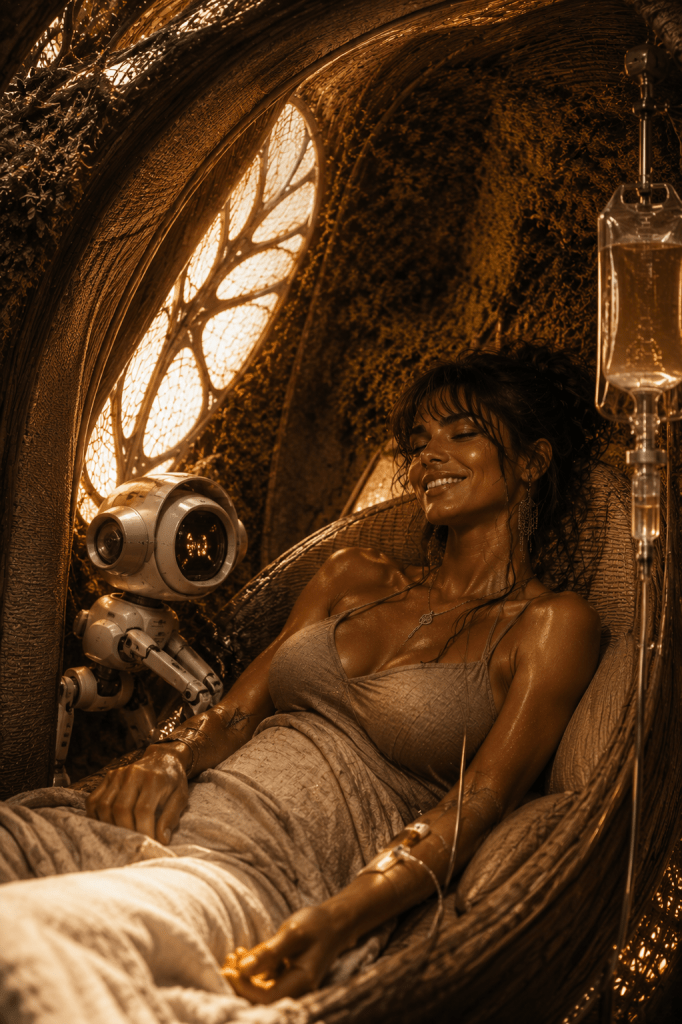
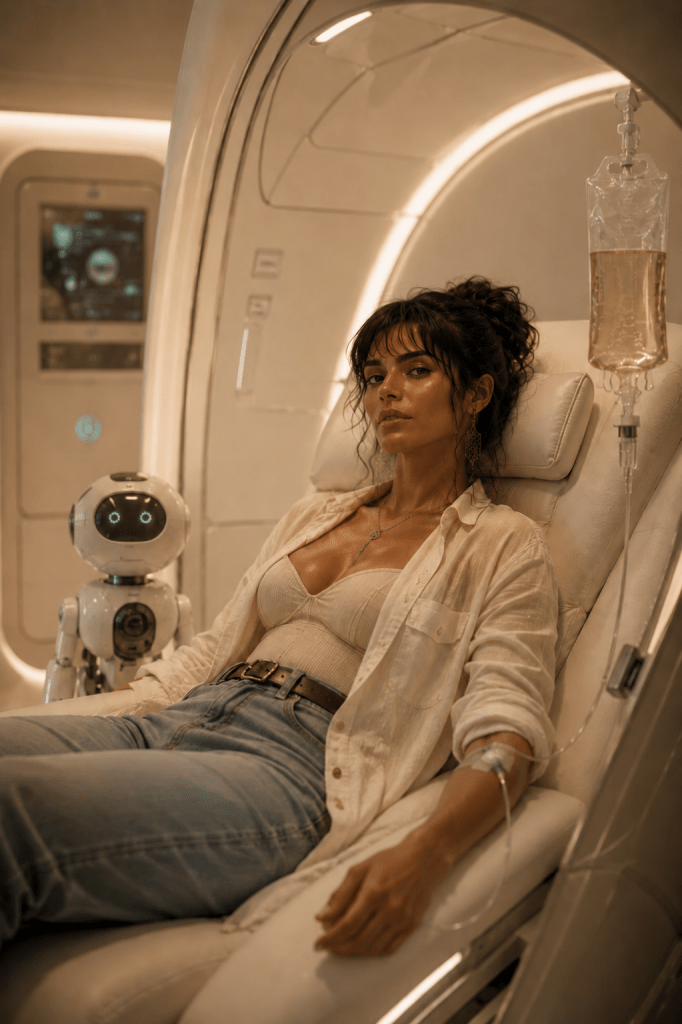
There are healing pods. Spaces — biological, technological, both simultaneously — where the body is tended the way it deserves to be tended. Not emergency rooms. Not waiting rooms with fluorescent lights and clipboards. Something closer to what a forest does to a nervous system, engineered deliberately, accessible to everyone, not just the people who can afford the retreat.
Rest as infrastructure. Recovery as a right. The understanding that a regulated nervous system is not a luxury — it is the precondition for everything else the civilization wants to produce.
The Medicine
Your personal medical robot is not your doctor’s tool. It is yours. It lives in your home, it knows your body’s baseline better than any appointment-based system ever could because it has been watching continuously — with your consent and yours alone. It tracks your sleep architecture, your inflammatory markers, your hormone cycles, your nervous system regulation. Not to sell that data to an insurer. Not to flag it to an employer. Not to share it with a government agency looking for reasons to remove you, institutionalize you, or weaponize your biology against you politically. To tell you, privately, what your body is doing and what it needs.
The data never touches a cloud. It lives on your device, encrypted, air-gapped from any external network unless you explicitly open that door. There is no central server where your health history sits waiting to be subpoenaed, breached, purchased, or used to build a case against you. There is no algorithm deciding whether your mental health history makes you a liability. There is no insurance model that prices your survival based on your diagnoses. The information exists in one place — with you — and it goes nowhere without your hand on the door.
This matters more than it sounds. We already live in a world where health data is used to discriminate in employment, to deny coverage, to inform custody decisions, to flag individuals as unstable or dangerous — often without their knowledge and always without their meaningful consent. The personal medical robot I’m describing is a direct counter to that architecture. It is diagnostic sovereignty. The right to know your own body without that knowledge being harvested by systems that profit from your vulnerability or fear your clarity.
Quantum computing changes what is possible in medicine in ways we are only beginning to understand. Protein folding problems that took decades to model — solved in minutes. Drug interaction matrices too complex for classical computing — mapped completely. Personalized treatment protocols generated not from population averages but from your specific biology, your specific genome, your specific history. Medicine that actually knows who you are rather than who the dataset says you probably are.
But the most radical application is not pharmaceutical. It is political.
Restorative justice powered by quantum biopolitics. The ability to model, with genuine precision, the biological and psychological impact of systemic harm on a body and a community over time. To quantify what structural violence costs a nervous system across generations. To make legible — in data that courts and institutions cannot dismiss — what survivors have always known and never been able to prove to the satisfaction of systems designed not to believe them.
Imagine a legal framework where the harm done to a body by poverty, by incarceration, by displacement, by torture, by sustained institutional neglect — could be measured, modeled, and argued with the same rigor currently reserved for financial damages. Where biopolitical harm has evidentiary weight. Where the body’s testimony is admissible because the technology can now read it.
That is not science fiction. That is quantum computing pointed at justice instead of profit.
The healing pod and the personal medical robot and the quantum justice framework are the same argument from three different angles: your body is yours, your data is yours, and what has been done to your body can be known, proven, and remedied — if we choose to build systems that serve that purpose rather than suppress it.
Nothing about your health should ever be used as a weapon against you. In the future I imagine building toward, it won’t be. Not because people became more trustworthy. Because the architecture won’t allow it.
The Digital Environment
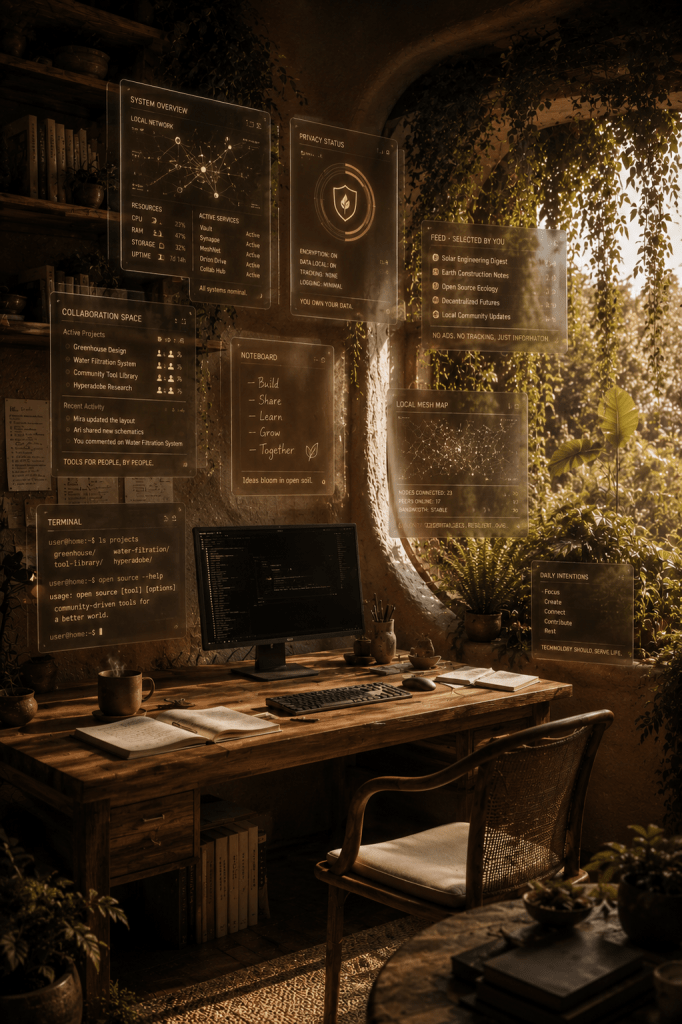
The digital environment is the same. Imagine a home with all the latest from the digital at home marketing space. But, just no marketing. No algorithms deciding what you see or who you are or what you need to buy or improve. But a fully immersive hybrid environment for producing, trading, and optimizing but privately and securely. Embedded open source useful tools — free at the point of use, maintained by the communities that depend on them, owned by no one, available to everyone. The at-home interface is productive and calm. Information flows toward you because you chose it, not because someone paid to put it there.
Privacy is not a premium feature. It is the default. The baseline. The floor below which no system is permitted to go. The rest is meant to optomize luxury and productivity. This would require that the economy have a floor, and that we revolutionize the mortgage industry so that working power isn’t wasted paying 15-30 years for a shelter that took 9 months to build.
The Travel
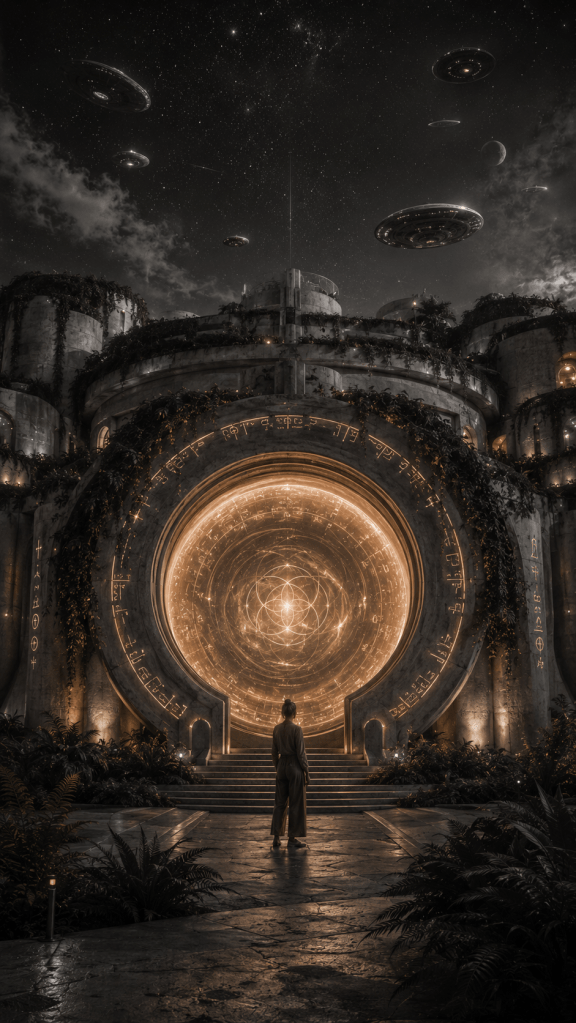
I imagine quantum travel stations.
Not airports. Not transit hubs. Something closer to a library or a sacred space — a place you go with intention, with preparation, with a clear reason for the journey. Public. Accessible. Staffed by people trained in temporal ethics the way doctors are trained in medical ethics — because the questions that arise when time is traversable are not technical questions. They are moral ones.
You go to visit your grandmother. You go to meet the version of your great-great-grandmother who survived something nobody recorded. You go to sit with an ancestor who died before you were born and tell them what became of the thing they fought for. You go to bring them forward — not to keep them, not to displace them, but to show them. To let them see that it mattered. That the thread held. They can do the same.
They can come to you. They can walk through a Tuesday in the world their choices helped build. They can meet your children. They can understand, in a way no letter or photograph or oral history can fully convey, what their life rippled into.
And then they go back. Because the timeline is not a toy. Because presence does not mean possession. Because the ethics of quantum travel are built on the same foundation as the ethics of everything else in this future — your time is yours, my time is mine, and crossing between them requires consent, care, and a clear accounting of what we are doing and why.
Timeline cleanup is real work in this future. The accumulated distortions of unethical interventions — the ones that happened before the framework existed, the ones that happened in the dark — require remediation. Teams of temporal ethicists and quantum navigators doing the slow, careful work of locating damage and addressing it without causing more. Restorative justice extended across time itself.
Trade happens across timelines. Not extraction — genuine exchange. Knowledge for knowledge. Skill for skill. A healer from one era offering what they know to a body in another. A builder from a time when Roman concrete was understood sitting with a community that wants to build that way again and sharing not just the formula but the culture that produced it. Healthcare across time. A cure developed in 2150 available to someone dying in 2026. The accumulated medical knowledge of every civilization that ever developed one, accessible as living conversation with the people who discovered it.
The infrastructure runs on quantum computers. The travel stations are connected through wormhole networks — stabilized, mapped, monitored. UFOs are not a mystery in this future. They are transit. Some ours. Some not. The acknowledgment that we are not alone and never were is not a crisis in this world — it is a fact integrated into the civilization’s self-understanding early enough that it shaped the ethics rather than destabilizing them.
Teleportation exists for matter as well as information. Not instantaneous in the way science fiction promised — more deliberate than that, more ceremonial. You don’t teleport the way you text. You teleport the way you travel. With intention. With preparation. With an understanding of what it means to disassemble and reassemble yourself across space.
Here is the caveat built into every quantum travel system at the architectural level — the rule that cannot be overridden because it is not imposed from outside but written into the physics of how the network operates:
You can only address your own misdeeds.
You cannot go back and change another person’s choices. You cannot alter what someone else decided, said, did, or became. The timeline is protected from that kind of intervention not by law but by design — the same way a well-built lock protects not by trusting everyone but by making violation structurally difficult regardless of intention.
What you can do is return to the moments where you caused harm and address them. Acknowledge. Make right where making right is possible. Carry the understanding back with you into the present and let it change how you move forward. The quantum travel system is, at its deepest level, a restorative justice tool for the individual soul.
The governance model is the same one that runs everything else in this future — radical transparency with sovereign boundaries. Everyone can see the timeline. The full record of what happened, what was changed, what was attempted, what was redirected — visible to the community the way open source code is visible. Not because surveillance is good but because secrecy is where abuse hides.
When timeline intervention is democratized — when it is not the exclusive tool of governments or corporations or individuals with enough money to access it privately — the incentive structure changes completely. A single powerful actor with private access to temporal technology is the most dangerous entity imaginable. A billion people with equal access, all of whom can see what everyone else is doing, none of whom can touch another person’s sovereign choices — that is a system that protects itself. The watchers watch each other. The timeline becomes a commons.
This is why the monitoring is distributed rather than centralized. Not a government agency watching from above. Not a corporation selling access. A community ledger — open, readable, held by everyone simultaneously — that makes timeline abuse not just illegal but practically impossible. Because the moment someone attempts to alter another person’s choices, every other person in the network can see it. The transparency is the protection. The democratization is the security. It also makes it safe for women to be at gas stations, targets, parks, and to live life again without fear for themselves or their children and family members, because crimes can be viewed via a quantum computer and prevented.
Every journey is logged. Not surveilled in the extractive sense of control— not stored on a central server to be used against you — but recorded in the distributed community ledger that exists to protect the integrity of the timeline rather than to police the traveler. The monitors are temporal ethicists, not enforcers. Their job is to flag interventions that approach the boundary of another person’s sovereign choices and redirect them before damage occurs.
You cannot fix someone else. You can only fix yourself. The universe, it turns out, already knew this. The quantum travel network was just built to agree.
Secrecy requires darkness. The quantum commons runs on light.

The Person
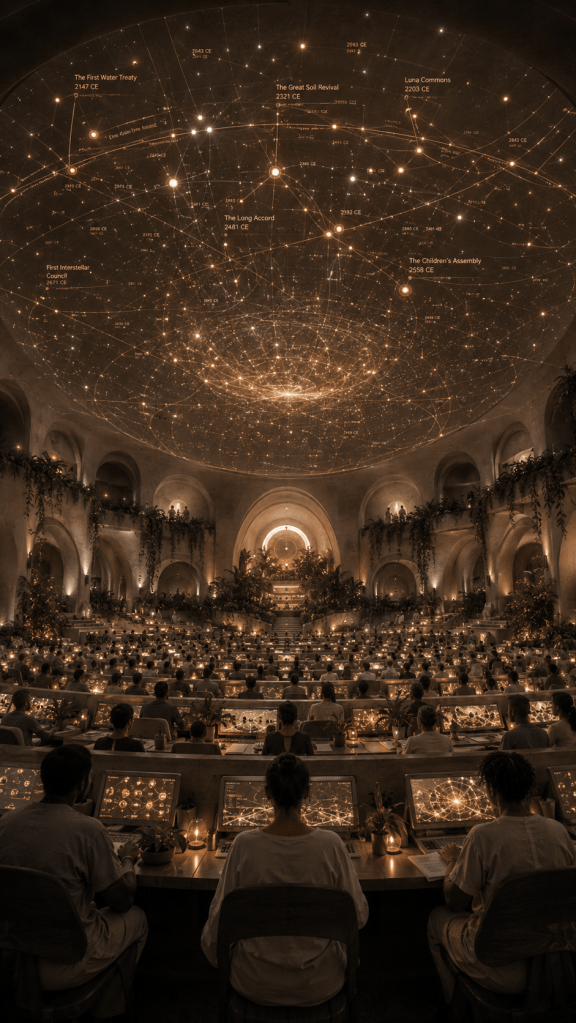
What version of myself would I hope to see? She moves through this city like she owns her life and her timeline and her piece of paradise — because she does, the way everyone else also does, which is differently from how anyone owned anything before. Ownership use to imply control, power dynamics, ego.
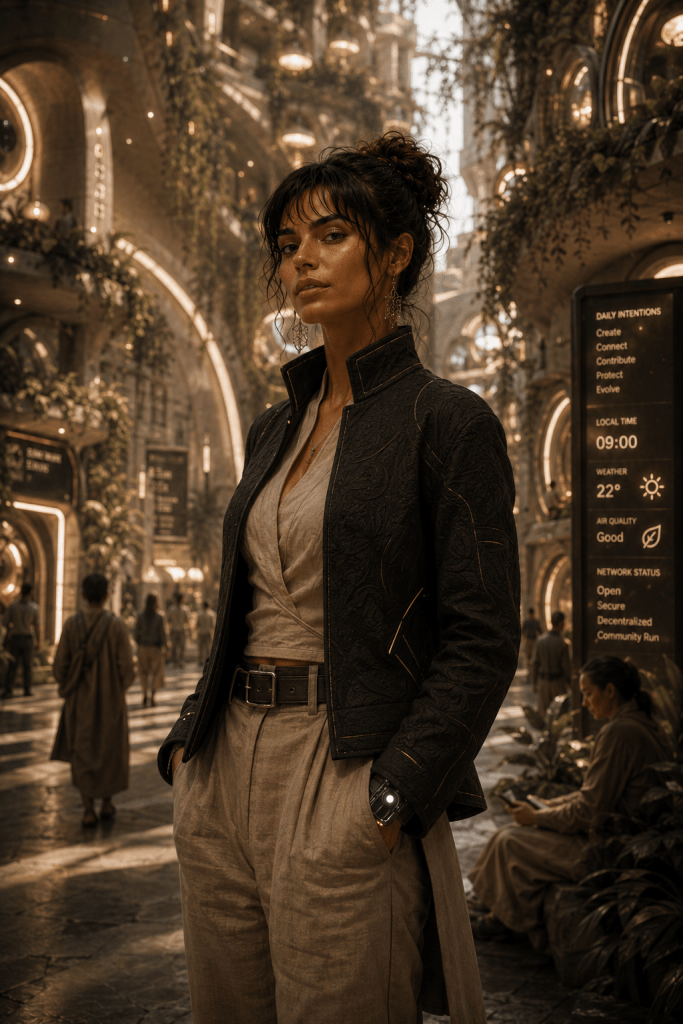
At 9am survival is already handled by the power of the collective and iterative infrastructure. The building fed her. The pod kept her informed to keep her health in balance. The open network gave her tools without asking for her data in return. She wasn’t in fear for survival, she was working with her environment to produce and solve problems, in balance and harmony with her own needs and rhythms. As is everyone else around her. A world full of trillionaires.
The rest of the day — all of it — is creation.
This Is Not Fantasy
Every element of this future exists in some form right now. 3D printed earthen buildings — exist. Cob and hyper-adobe construction — ancient and proven. Roman concrete — rediscovered and studied. Biogas from human waste — exists. Vertical farming — exists. Open source automation — exists. Decentralized energy grids — exist. Personal health monitoring — exists. Air-gapped encryption — exists. The healing technology — emerging. The conductive textile — in development. Quantum computing in medicine — accelerating faster than most people know.
What doesn’t exist yet is the political will to point all of it in the same direction at the same time for the benefit of everyone rather than the profit of a few.
That is the only thing standing between now and the future I just described. Not technology. Not resources. Not human nature.
Policy. Vision. And enough people holding the same picture of what’s possible until it becomes too obvious to ignore.
I am one of those people. This blog is part of that project. Every post, every framework, every prompt, every image is a small piece of the architecture of a world that I wish did already exist and doesn’t yet.
The cyberpunk future I want is not coming to save me. I am going to have to figure out how to build it, even if just gathering seeds, materials, or visioning and sharing ideas for the future. Thought by thought. Seed by seed. Brick by hand shaped brick. Loop by loop. Blog by blog. Robot by robot. Algorithm by algorithm.
Starting now.
 ASH & INK
Leave a comment